
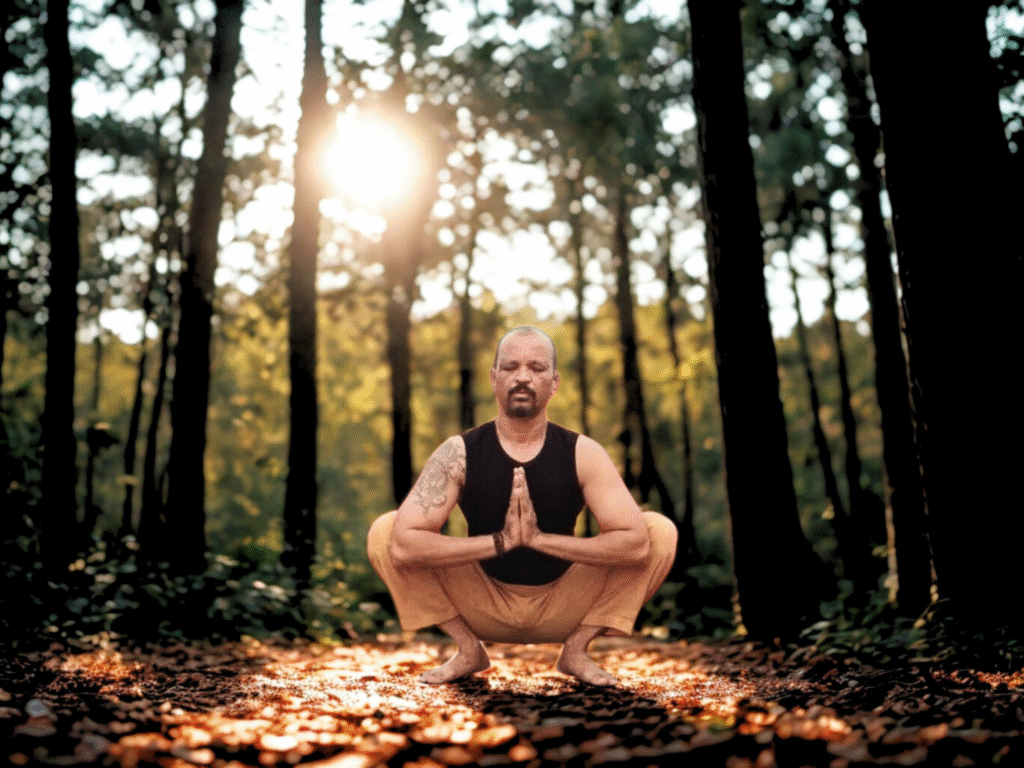
Mālāsana, often introduced to students as “Garland Pose,” is more accurately – and powerfully – understood when we revisit the Sanskrit. The word “mala” doesn’t refer to a garland of flowers, but rather to waste or excrement – what the body is ready to eliminate. Mālāsana, then, is not just a pretty squat. It is a ritual of release – a posture of deep letting go, physically and energetically.
Physically, Mālāsana strengthens the legs, stretches the hips, groin, and ankles, and supports digestive function by compressing the abdominal region. It’s especially beneficial for those who spend long hours sitting or experience stiffness in the hips and lower back. With the spine long, the chest open, and the pelvis heavy toward the earth, this pose brings you into a posture of primal grounding.
Psychologically, Mālāsana encourages humility, stillness, and presence. It draws awareness downward, into the lower energy centers, and invites us to pause – to release what we’ve been gripping, physically or emotionally. Energetically, it activates the Mūlādhāra (root) chakra, enhancing stability, grounding, and trust in the body.
Props such as blankets under the heels or blocks under the sit bones make the pose more accessible, especially for those with tight hips or ankle mobility issues.
Rather than chasing depth, invite stillness. The magic of Mālāsana lies in what you’re willing to let drop – not how low you go.